


Click Below to Get the Code

Browse, clone, and build from real-world templates powered by Harper.
Solution
GitHub Logo

Early Hints: Faster First Impressions

Harper’s Early Hints solution accelerates web performance by sending critical assets to browsers using HTTP 103 responses before the full page loads, improving Core Web Vitals, SEO, and conversions. Built on Harper’s fused architecture, it delivers sub-2 ms latency at scale with zero changes to application code.
Solution

Early Hints: Faster First Impressions

at Harper
July 11, 2025
at Harper
July 11, 2025
at Harper
July 11, 2025
July 11, 2025
Harper’s Early Hints solution accelerates web performance by sending critical assets to browsers using HTTP 103 responses before the full page loads, improving Core Web Vitals, SEO, and conversions. Built on Harper’s fused architecture, it delivers sub-2 ms latency at scale with zero changes to application code.

In the competitive landscape of web applications, every millisecond between request and render is an opportunity to captivate or cull potential customers.

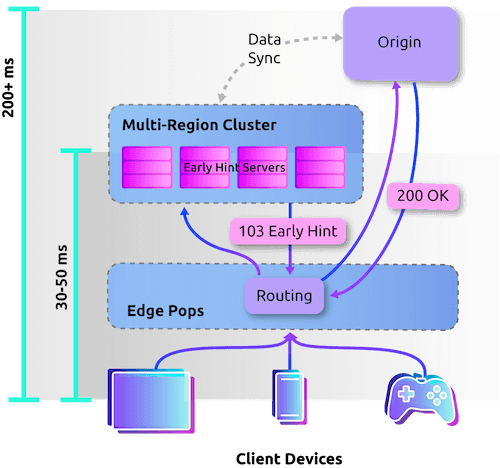
Harper’s Early Hints solution shortens the wait by prompting web clients to proactively download high-priority resources using a partial 103 HTTP response before the full 200 response is returned. That means by the time your application is ready to render a hero image, key css, or mission-critical JavaScript, the browser already has it.

The result? Faster time-to-interaction, improved CWVs (Core Web Vitals) like LCP (Largest Contentful Paint), and better outcomes across the board—from SEO to conversions.

Why Performance Still Wins

For many, web performance has matured from a front-end afterthought to a board-level priority. Whether you're building an e-commerce site, a travel booking platform, or a global news site, speed is a key growth lever.

Even minor delays in response time can cause significant degradation in CWVs, bounce rates, and conversions. And as applications become more dynamic and data-driven, the gap between request initiation and response generation has widened.

That’s the window Early Hints is designed to target: the idle latency that exists between the initial request and your server’s full response. With Harper, you convert that downtime into a head start.

The Harper Early Hints Solution

Harper approaches Early Hints as a native extension of its fused architecture, where compute, storage, and caching functions are delivered in the same runtime, ensuring extreme performance at scale. Distributed to multiple regions, Harper minimizes both server and network latency, ensuring hints arrive before HTML content. 

Key Benefits:

  • Accelerated Page Loads
    Preload critical assets (fonts, CSS, images) before HTML content, decreasing load times by a few hundred milliseconds—improving Core Web Vitals, SEO, and conversion rates.

  • Built for Scale
    Harper responds to Early Hint requests with P95 server-side latency under 2 ms, even across hundreds of millions of records, with end-to-end delivery typically complete in 30–50 ms.

  • Composable Edge Execution
    Add capabilities like redirect management or above-the-fold asset delivery without requiring additional systems, allowing you to maximize the value of your investment.
Get Started

Early Hints enhance page performance without modifying a single line of application logic. Whether you're optimizing for Core Web Vitals to drive SEO or delivering lightning-fast experiences to boost conversions, Harper makes low-latency easy.

Contact our team at sales@harperdb.io to activate Early Hints today.

In the competitive landscape of web applications, every millisecond between request and render is an opportunity to captivate or cull potential customers.

Harper’s Early Hints solution shortens the wait by prompting web clients to proactively download high-priority resources using a partial 103 HTTP response before the full 200 response is returned. That means by the time your application is ready to render a hero image, key css, or mission-critical JavaScript, the browser already has it.

The result? Faster time-to-interaction, improved CWVs (Core Web Vitals) like LCP (Largest Contentful Paint), and better outcomes across the board—from SEO to conversions.

Why Performance Still Wins

For many, web performance has matured from a front-end afterthought to a board-level priority. Whether you're building an e-commerce site, a travel booking platform, or a global news site, speed is a key growth lever.

Even minor delays in response time can cause significant degradation in CWVs, bounce rates, and conversions. And as applications become more dynamic and data-driven, the gap between request initiation and response generation has widened.

That’s the window Early Hints is designed to target: the idle latency that exists between the initial request and your server’s full response. With Harper, you convert that downtime into a head start.

The Harper Early Hints Solution

Harper approaches Early Hints as a native extension of its fused architecture, where compute, storage, and caching functions are delivered in the same runtime, ensuring extreme performance at scale. Distributed to multiple regions, Harper minimizes both server and network latency, ensuring hints arrive before HTML content. 

Key Benefits:

  • Accelerated Page Loads
    Preload critical assets (fonts, CSS, images) before HTML content, decreasing load times by a few hundred milliseconds—improving Core Web Vitals, SEO, and conversion rates.

  • Built for Scale
    Harper responds to Early Hint requests with P95 server-side latency under 2 ms, even across hundreds of millions of records, with end-to-end delivery typically complete in 30–50 ms.

  • Composable Edge Execution
    Add capabilities like redirect management or above-the-fold asset delivery without requiring additional systems, allowing you to maximize the value of your investment.

Get Started

Early Hints enhance page performance without modifying a single line of application logic. Whether you're optimizing for Core Web Vitals to drive SEO or delivering lightning-fast experiences to boost conversions, Harper makes low-latency easy.

Contact our team at sales@harperdb.io to activate Early Hints today.

Harper’s Early Hints solution accelerates web performance by sending critical assets to browsers using HTTP 103 responses before the full page loads, improving Core Web Vitals, SEO, and conversions. Built on Harper’s fused architecture, it delivers sub-2 ms latency at scale with zero changes to application code.

Download

White arrow pointing right
Harper’s Early Hints solution accelerates web performance by sending critical assets to browsers using HTTP 103 responses before the full page loads, improving Core Web Vitals, SEO, and conversions. Built on Harper’s fused architecture, it delivers sub-2 ms latency at scale with zero changes to application code.

Download

White arrow pointing right
Harper’s Early Hints solution accelerates web performance by sending critical assets to browsers using HTTP 103 responses before the full page loads, improving Core Web Vitals, SEO, and conversions. Built on Harper’s fused architecture, it delivers sub-2 ms latency at scale with zero changes to application code.

Download

White arrow pointing right

Explore Recent Resources

News
GitHub Logo

Harper Recognized as an Honorable Mention in the 2026 Gartner® Magic Quadrant™ for Cloud-Native Application Platforms

Harper’s inclusion highlights a broader shift toward integrated cloud-native platforms that unify data, caching, messaging, and application logic. The article explains how Harper’s distributed runtime and managed infrastructure reduce operational complexity, improve performance, and support modern applications and AI agents that require fast, reliable access to state, events, and tools.
Announcement
News
Harper’s inclusion highlights a broader shift toward integrated cloud-native platforms that unify data, caching, messaging, and application logic. The article explains how Harper’s distributed runtime and managed infrastructure reduce operational complexity, improve performance, and support modern applications and AI agents that require fast, reliable access to state, events, and tools.
Person with short dark hair and moustache, wearing a colorful plaid shirt, smiling outdoors in a forested mountain landscape.
Aleks Haugom
Senior Manager of GTM
News

Harper Recognized as an Honorable Mention in the 2026 Gartner® Magic Quadrant™ for Cloud-Native Application Platforms

Harper’s inclusion highlights a broader shift toward integrated cloud-native platforms that unify data, caching, messaging, and application logic. The article explains how Harper’s distributed runtime and managed infrastructure reduce operational complexity, improve performance, and support modern applications and AI agents that require fast, reliable access to state, events, and tools.
Aleks Haugom
Aug 2026
News

Harper Recognized as an Honorable Mention in the 2026 Gartner® Magic Quadrant™ for Cloud-Native Application Platforms

Harper’s inclusion highlights a broader shift toward integrated cloud-native platforms that unify data, caching, messaging, and application logic. The article explains how Harper’s distributed runtime and managed infrastructure reduce operational complexity, improve performance, and support modern applications and AI agents that require fast, reliable access to state, events, and tools.
Aleks Haugom
News

Harper Recognized as an Honorable Mention in the 2026 Gartner® Magic Quadrant™ for Cloud-Native Application Platforms

Harper’s inclusion highlights a broader shift toward integrated cloud-native platforms that unify data, caching, messaging, and application logic. The article explains how Harper’s distributed runtime and managed infrastructure reduce operational complexity, improve performance, and support modern applications and AI agents that require fast, reliable access to state, events, and tools.
Aleks Haugom
News
GitHub Logo

Harper 5.2: More Throughput per Node, Fewer Systems Around It

Harper 5.2 helps architecture and platform leaders improve performance, control infrastructure costs, secure production workloads, and reduce operational complexity by bringing faster data access, agentic capabilities, scheduling, backup, routing, and protection into one unified runtime.
Product Update
News
Harper 5.2 helps architecture and platform leaders improve performance, control infrastructure costs, secure production workloads, and reduce operational complexity by bringing faster data access, agentic capabilities, scheduling, backup, routing, and protection into one unified runtime.
Person with short dark hair and moustache, wearing a colorful plaid shirt, smiling outdoors in a forested mountain landscape.
Aleks Haugom
Senior Manager of GTM
News

Harper 5.2: More Throughput per Node, Fewer Systems Around It

Harper 5.2 helps architecture and platform leaders improve performance, control infrastructure costs, secure production workloads, and reduce operational complexity by bringing faster data access, agentic capabilities, scheduling, backup, routing, and protection into one unified runtime.
Aleks Haugom
Aug 2026
News

Harper 5.2: More Throughput per Node, Fewer Systems Around It

Harper 5.2 helps architecture and platform leaders improve performance, control infrastructure costs, secure production workloads, and reduce operational complexity by bringing faster data access, agentic capabilities, scheduling, backup, routing, and protection into one unified runtime.
Aleks Haugom
News

Harper 5.2: More Throughput per Node, Fewer Systems Around It

Harper 5.2 helps architecture and platform leaders improve performance, control infrastructure costs, secure production workloads, and reduce operational complexity by bringing faster data access, agentic capabilities, scheduling, backup, routing, and protection into one unified runtime.
Aleks Haugom
Blog
GitHub Logo

5 Architectures for Web Personalization

Personalization is a data-delivery problem. Every architectural choice reduces to two distances: compute to user, and compute to fresh data. This piece maps five real architectures against both axes, scored on a concrete retailer workload where stale or slow data breaks the business.
Blog
Personalization is a data-delivery problem. Every architectural choice reduces to two distances: compute to user, and compute to fresh data. This piece maps five real architectures against both axes, scored on a concrete retailer workload where stale or slow data breaks the business.
Person with short dark hair and moustache, wearing a colorful plaid shirt, smiling outdoors in a forested mountain landscape.
Aleks Haugom
Senior Manager of GTM
Blog

5 Architectures for Web Personalization

Personalization is a data-delivery problem. Every architectural choice reduces to two distances: compute to user, and compute to fresh data. This piece maps five real architectures against both axes, scored on a concrete retailer workload where stale or slow data breaks the business.
Aleks Haugom
Jul 2026
Blog

5 Architectures for Web Personalization

Personalization is a data-delivery problem. Every architectural choice reduces to two distances: compute to user, and compute to fresh data. This piece maps five real architectures against both axes, scored on a concrete retailer workload where stale or slow data breaks the business.
Aleks Haugom
Blog

5 Architectures for Web Personalization

Personalization is a data-delivery problem. Every architectural choice reduces to two distances: compute to user, and compute to fresh data. This piece maps five real architectures against both axes, scored on a concrete retailer workload where stale or slow data breaks the business.
Aleks Haugom